
Send the Robots, Not the Cops

Public protest is a normal part of American life. It is protected, expected, and often necessary. People have the right to gather, speak, and push back against institutions. That right is not the issue at all. The issue starts when a protest crosses the line into violence.
Once people begin attacking others, destroying property, or turning a public space into an unsafe environment, it stops being a protest and becomes an unlawful assembly. At that point the state still has an obligation to restore order. The only question is how to do it without turning the situation into something worse.
Right now the tools are blunt. Police lines, batons, rubber bullets, tear gas, and in extreme cases live fire. Nobody wants to see videos of officers shooting into a crowd or deaths. But at the same time, cities cannot simply allow mobs to burn buildings, cars and assault people. There has to be a middle ground between “do nothing” and “use lethal force.”
For ground deployment: robotic units
Machines like Boston Dynamics’ Spot already exist. They are mobile, stable, and designed to operate in rough terrain where humans might struggle. Most people think of them as novelty tech or warehouse tools, but they make far more sense as non-lethal public safety equipment. Plus, they look cool and are a great symbol of how technologically far humans have come.
Imagine a violent protest where objects are being thrown and fires are started. Instead of sending officers directly into that chaos, you deploy robotic units first.
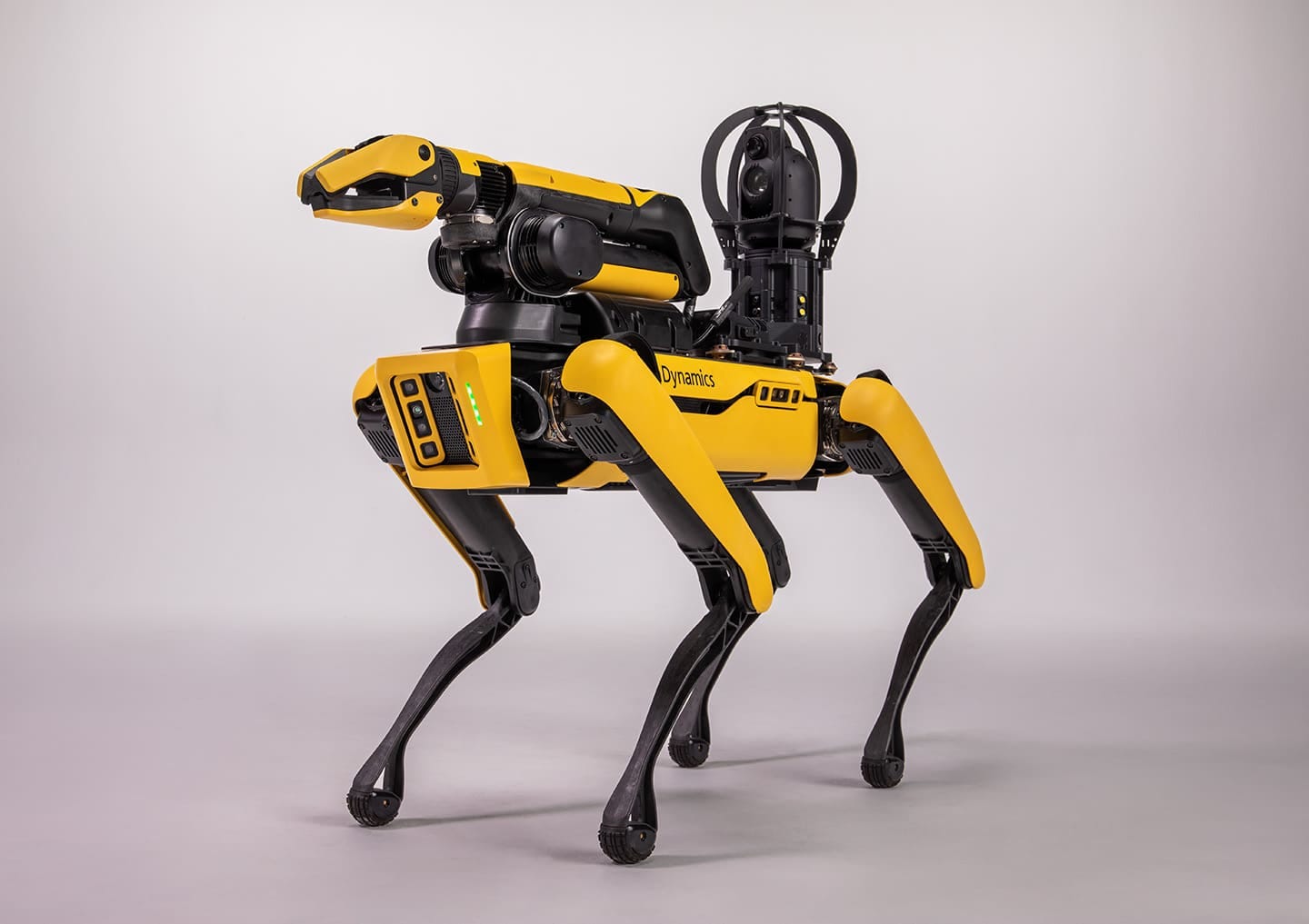
A robot dog does not panic or get angry. It cannot be baited or emotionally escalated. It can carry a loudspeaker to issue clear dispersal warnings. It can project instructions in multiple languages (very relevant in some cases). It can carry non-lethal deterrents like high-intensity sound, smoke, or irritant dispersal systems to push crowds back without permanent harm. Like a watered down ‘discombobulator’.
More importantly, it creates distance between humans. If someone kicks or attacks the robot, no one is injured. If the machine is damaged, you just replace the hardware. That alone lowers the temperature of the entire interaction. The optics also change. A robot dispersing a riot looks a lot less better than an officer pointing a rifle.
For air support: drones
Drones add the second layer. From above, they can broadcast announcements, spotlight dangerous areas, and monitor movement in real time. They can also document what is actually happening instead of relying on conflicting eyewitness accounts.
That last part matters more than people think. When property is destroyed or someone is assaulted, arrests do not have to happen in the middle of a chaotic crowd. Drones can capture clear footage and identify individuals responsible for violence. Police can then make arrests later, calmly and precisely, instead of escalating tensions during the event.
This reduces mass confrontation. Instead of swinging batons at everyone or getting trigger happy, enforcement becomes targeted and evidence-based.
Why this is better than the alternatives
The goal is not to militarize policing. I think it’s the opposite. It is to remove direct human confrontation wherever possible. The dogs and drones won’t be armed with any weapons. At most they’ll have smoke.
There is also a psychological factor. People are less likely to escalate when they are not directly confronting another human. A robot does not feel like a personal enemy. It feels more like a barrier. Of course there will be people who literally only attend protests to cause chaos and instigate issues, but that’s what our technology is for. It’s not the end of the world if someone damages a Spot. They can be fined and instead of a human being attacked, it was a piece of technology.
None of this replaces the right to protest. Peaceful demonstrations would never see this equipment. It would be a last resort for when crowds have been informed multiple times to leave but refuse to. Once a gathering turns violent, the priority shifts to protecting bystanders, businesses, and the city itself.
If the choice is between deploying officers with guns or deploying machines with speakers and non-lethal tools, the answer seems quite obvious.
Ironically, it seems like sometimes the most humane option is not more people.